Monday, March 27, 2006

Broken Records

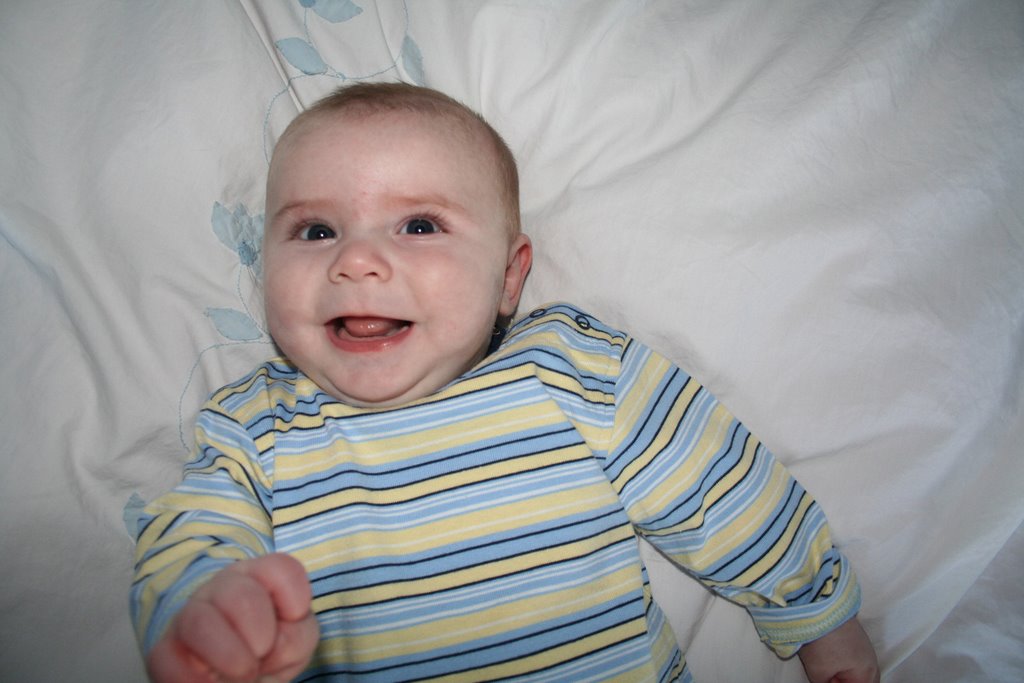
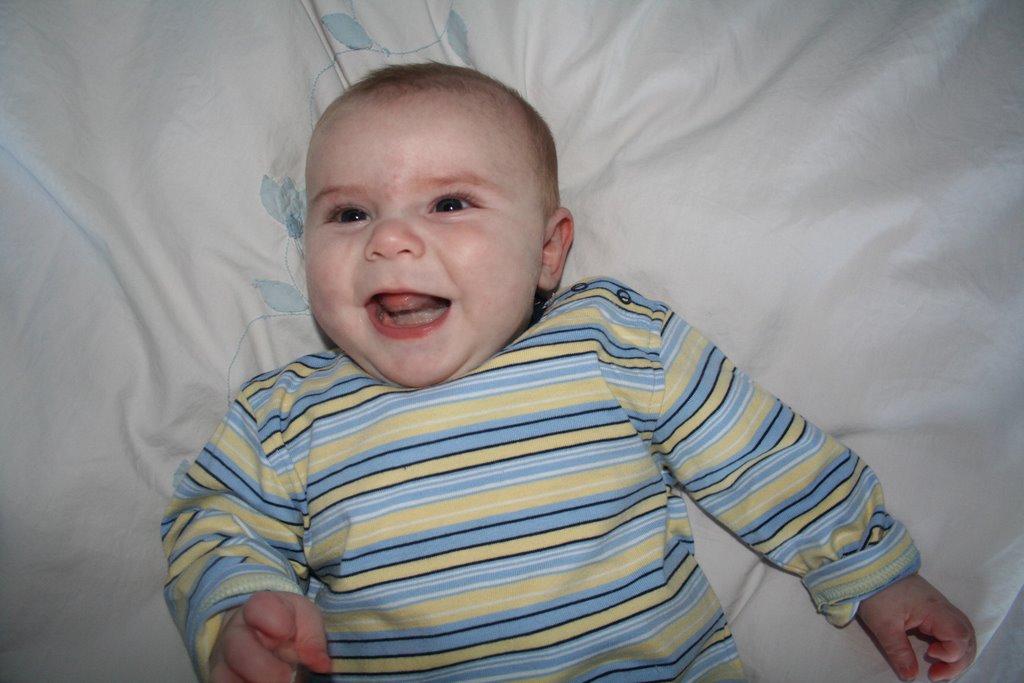
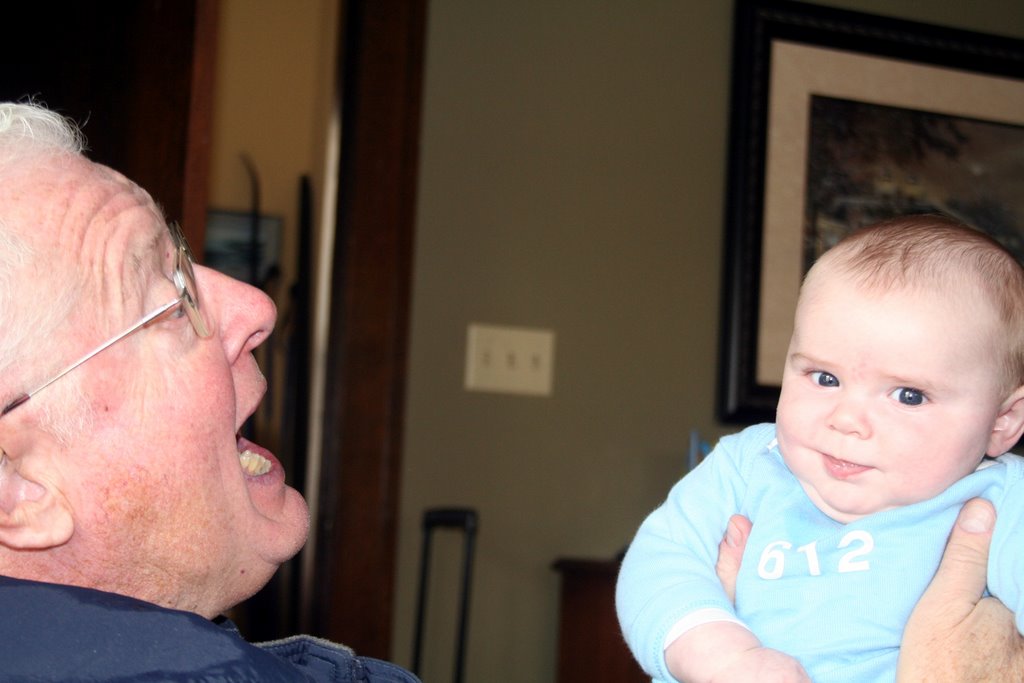
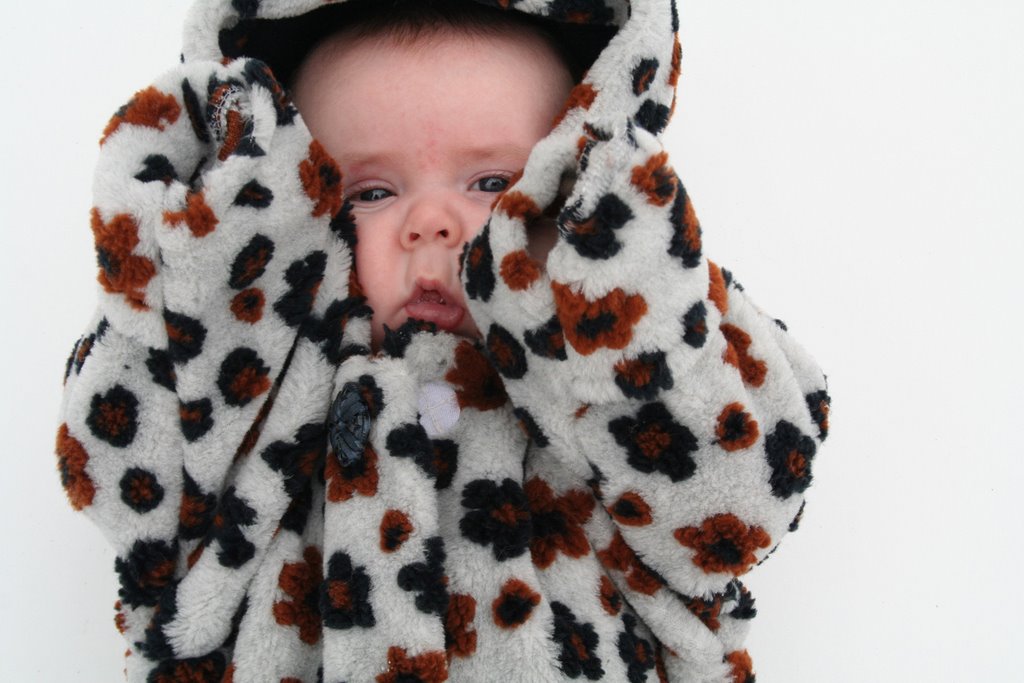
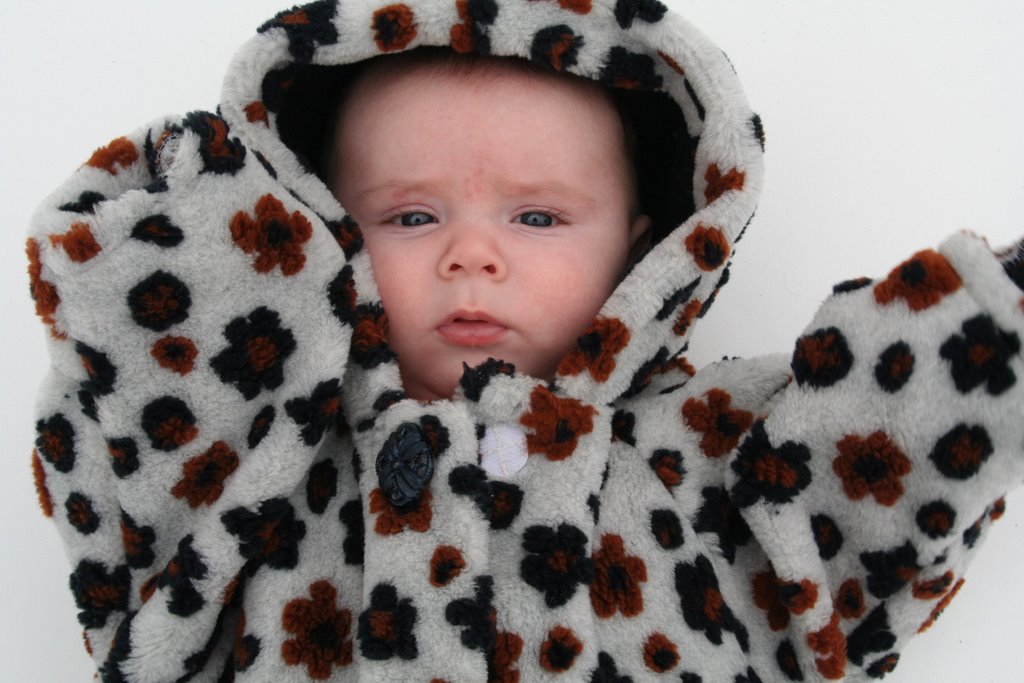
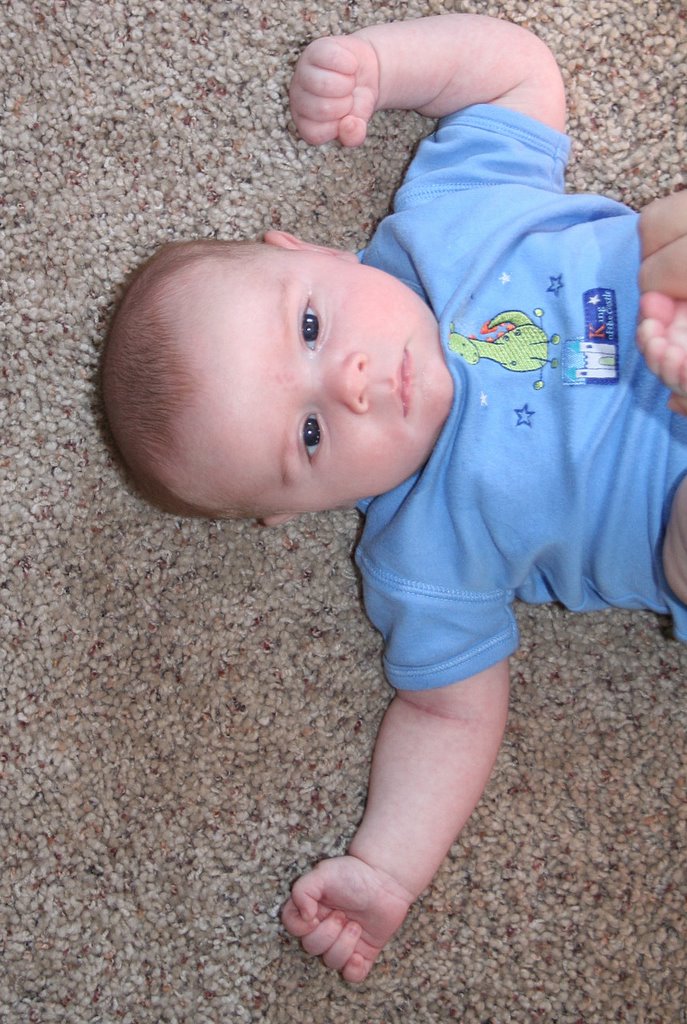
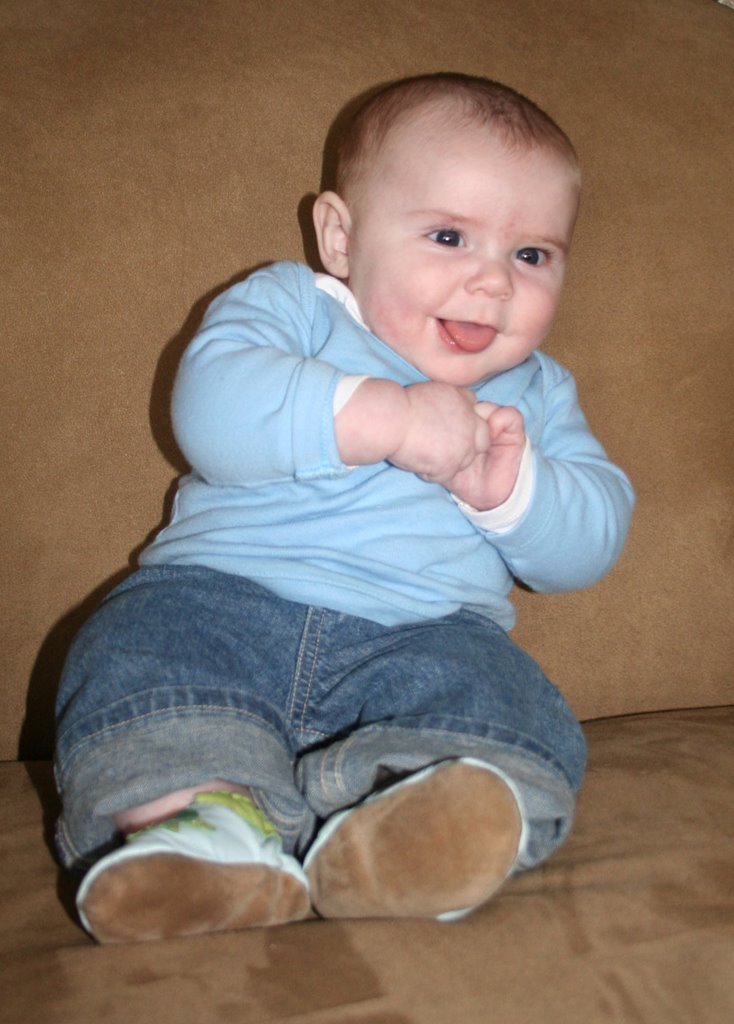
As of last Friday, Mr. Big was 18 lbs 3 0z, at 15 weeks, that growth indicates a 97% increase since 9 December. At the time of writing this post, he is taking his morning nap (it began at 8:22 a.m.) after sleeping a record 11 hours straight last night without a peep (from 8 p.m. to 6:47 a.m.)!


Sunday, March 26, 2006

Stats 101

Any advice on how to explain to SYO that it is not statistically possible for Sidekick to ALWAYS get the bigger cookie/roll/brownie/piece of cake etc. etc. is sought.


Friday, March 24, 2006

Chinese Seeking Identity In America

Here is a nice New York Times piece for all of you out there in the process
(or have gone through the process) of adopting from China via the Freakonomics Blog.

Some snippets:

As the oldest of the adopted children move through their teenage years, they are beginning - independently and with a mix of enthusiasm and trepidation - to explore their identities. Their experiences offer hints at journeys yet to come for thousands of Chinese children who are now becoming part of American families each year.

Those experiences are influenced by factors like the level of diversity in their neighborhoods and schools, and how their parents expose them to their heritage.

"We're unique," Qiu Meng said.

. . .
Jane Brown, a social worker and adoptive parent who conducts workshops for adopted children and their families, says the families should directly confront issues of loss and rejection, which the children often face when they begin to understand the social and gender politics that caused their families in China to abandon them.

Thursday, March 23, 2006

Working Girls

Taggert over at A Random Walk tipped me off to this recent article, "Working Girls" in Prospect, by Alison Wolf.

Her main point:

[F]or the first time, women, at least in developed societies, have virtually no career or occupation barred to them.

This marks a rupture in human history. It is one that has brought enormous benefits to many people, and to many women in particular. But its repercussions are not all positive, either for society as a whole, or for all women. We are no more likely to return to the old patterns than we are to subsistence agriculture, so we need to understand what the new female labour market means for all our lives.

Three consequences get far less attention than they deserve.

The first is the death of sisterhood: an end to the millennia during which women of all classes shared the same major life experiences to a far greater degree than did their men.

The second is the erosion of "female altruism," the service ethos which has been profoundly important to modern industrial societies—particularly in the education of their young, and the care of their old and sick.

The third is the impact of employment change on childbearing. We are familiar with the prospect of demographic decline, yet we ignore, sometimes wilfully, the extent to which educated women face disincentives to bear children.


I can't decide if this is an article that says something to the effect of, for all that change, we are really still the same, or whether or not it points to really interesting shifts in our culture. See below (my bolds).


One could interpret today's feminist assumptions as reflecting the appetite of global capitalism for all talent, female and male, at the expense of the family. Certainly our current economic arrangements offer precious little support to family formation. On the contrary, they erect major barriers in its way. We all know by now that in most developed countries, birth rates are well below replacement level. Less recognised is the massive change in incentives to have children. In the past, adults had no tax-financed welfare state to depend on. Their families were their social insurance policies: children paid. Today, they expect the state to take care of their financial and health needs when ill or retired, regardless of whether they have six children or none. The benefits we get are completely unrelated to whether or not we contribute a future productive member to the economy.

Moreover, our labour market, with its greater gender equality, makes childbearing a very expensive prospect for successful professionals. Rearing a healthy, balanced child requires intensive attention and large amounts of time, and is not something that technical progress is going to alter. The price of that time is especially high for high-earning, busy elite parents—female or male. If they give up or cut down on work, the opportunity cost in terms of income forgone and careers stalled is far greater than for an unskilled 16-year-old school-leaver. In addition, elite children are expensive. Children are dependent for longer, high-quality childcare is costly and formal education has become increasingly important as the route to success. Parents know this, and it explains why the professional classes devote so much money and attention to their children's schooling.
. . .
The hard economics tells us that professional women will have to give up most if they have children, and so will be least inclined to do so. Highly educated women overwhelmingly stay in work and so pay little or no earnings penalty when they have children. But more and more of them in the developed world have no children at all. "The rich get richer and the poor have children" still applies; but this time around, it is women specifically that we are talking about. About 30 per cent of graduate women born in the early 1960s entered their forties childless. For graduate women born in 1970 (a substantially larger group) the expected figure is 40 per cent.

Unlike professional graduates, childbearing is a rational career choice for academically failing girls and one that a good many duly select, especially in countries where they are supported by the state.

Wednesday, March 22, 2006

Sunday, March 19, 2006

More on The Phenomenon of Women Choosing to Have Children Sans Men

There has been a recent flurry of attention paid to the apparently growing number of women having children (by choice) without men. This includes both heterosexual and lesbian women, and the statistics attempt to exclude accidental out-of-wedlock births.

The latest installment is from Sunday's New York Times Magazine, Wanted: A Few Good Sperm
by Jennifer Egan which focuses on a few women who are choosing to conceive without husbands, boyfriends, or even prospects of partners.

One hopes to join a population of women that everyone agrees is expanding, although by how much is hard to pin down because single mothers by choice (or choice mothers), as they are sometimes called, aren't separated statistically from, say, babies born to unwed teenagers. Between 1999 and 2003 there was an almost 17 percent jump in the number of babies born to unmarried women between ages 30 and 44 in America, according to the National Center for Human Statistics, while the number born to unmarried women between 15 and 24 actually decreased by nearly 6 percent. Single Mothers by Choice, a 25-year-old support group, took in nearly double the number of new members in 2005 as it did 10 years ago, and its roughly 4,000 current members include women in Israel, Australia and Switzerland. The California Cryobank, the largest sperm bank in the country, owed a third of its business to single women in 2005, shipping them 9,600 vials of sperm, each good for one insemination.

Most of these articles focus on changing social norms:

As recently as the early 60's, a "respectable" woman needed to be married just to have sex, not to speak of children; a child born out of wedlock was a source of deepest shame. Yet this radical social change feels strangely inevitable; nearly a third of American households are headed by women alone, many of whom not only raise their children on their own but also support them. All that remains is conception, and it is small wonder that women have begun chipping away at needing a man for that — especially after Sylvia Ann Hewlett's controversial 2002 book, "Creating a Life: Professional Women and the Quest for Children," sounded alarms about declining fertility rates in women over 35.

. . .

In the 25 years since she founded Single Mothers by Choice after becoming pregnant by accident, Jane Mattes, now 62, has seen her group's membership conceiving at younger ages (the median age among members is 36) and more often having second children. But the biggest change, Mattes says, is that the stigma attached to this form of single motherhood has largely faded. "People used to come into our meetings literally afraid to walk in," she told me. "We don't see that as much anymore. Everyone seems to know somebody who did it, which wasn't the case even 10 years ago."


Others on the technology and economics of it all:

The Internet is also a factor; as well as holding meetings through local chapters around the country, Single Mothers by Choice hosts 11 Listservs, each addressing a different aspect of single motherhood. Women around the world pore over these lists, exchanging tips and information, selling one another leftover vials of sperm. (Once sperm has shipped, it can't be returned to the bank.) Karyn found both her sperm bank and reproductive endocrinologist on these Listservs. Three-quarters of the members of Single Mothers by Choice choose to conceive with donor sperm, as lesbian couples have been doing for many years — adoption is costly, slow-moving and often biased against single people. Buying sperm over the Internet, on the other hand, is not much different from buying shoes.

Still others concentrate on the no-man part of the story. I'd put this article in that camp. Here are a few snippets:

Now, as we sat outside, she said: "There's nothing I'd like more in life than to have the whole picture and to share it all. To have the baby, to have the miniwagon, to have the husband, morning soccer games and P.T.A. — he's out manning the grill, and I'm mixing the margaritas. But I think if I had to choose today between becoming a mom or finding the perfect man and I could only have one today, I would choose becoming a mom. And hope that I have my lifetime to find the other."

"Maybe in six months or a year I'll have more insight about it, but something radical is going on in my brain about my relationships with men. O.K., so I'm not going to keep trying to have this picket-fence-y life. I'm waving the white flag. And now I have permission to directly pursue what I want. It's a very curious and ambivalent liberation, because I would rather not be single. It's not my first choice."


Glossary:

"proven fertility": meaning that at least one woman conceived using his sperm

"identity-release donor" (also called an "open donor" or a "yes donor"); a growing and extremely popular category of sperm donors who are willing to be contacted by any offspring who reach the age of 18.

Saturday, March 18, 2006

Why Wisconsin Is Good

Even if you don't care about the packers:

Check out this article from the Washington Post: Wisconsin Voters Prepare to Weigh In On the War in Iraq

From Baraboo and Monona to Madison and La Crosse, antiwar activists invoked a 1911 state law to schedule a bring-the-troops-home referendum designed to send a message to Congress and the White House that the war is costing too many lives and too much money.

Friday, March 17, 2006

I Have To Admit, It's Gettin' Better! It's Gettin' Better All the Time

Thank God for adreneline.

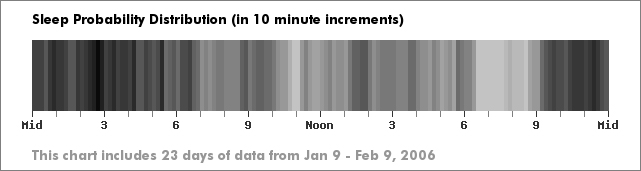
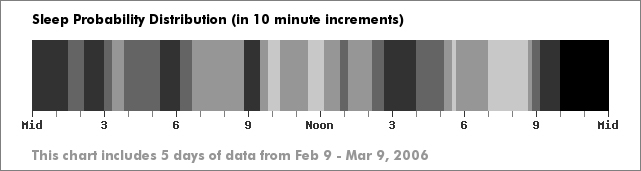
The below images are probability distributions of sleep for ZeYo for a) 0-1 month, b) the first month, c) the second month and d) the third month.

The interpretation is this: black = probability of 1 that he is asleep and white = probability of 1 that he is awake.

Here is the description from the (genius) programmer:

The number of gray scale values depends on the number of days in your chart. If you have two days in your chart, then there will be three colors: black, 50% gray and white. The reason is that the different possibilities for being asleep at a given time for the two days would be:
2/2 (100% - asleep both days at a given time),
1/2 (50% - asleep one day, not the other at a given time) and
0/2 (0% - asleep neither day at a given time).

The more days in your sample, the more possible gray scale values. So if you have a months worth of data (31 days max), there will be 32 shades of gray:
(0/31 through 31/31). This would be approximately 0% black, 3% black, 6% black, 10% black, etc...


It's no wonder new parents are exhausted.


To get this data, I participate in the beta version of some very fun software that I recommend to new parents. Check out Trixie Tracker which just launched last week!

I found the "telemetries" as they are called, to be invaluable, especially in the first month. We were able to keep track of inputs and outputs, sleep, medicine, nursing, etc. At this point, we have devolved down to basically just sleep. During the second month you'll notice that I have less data. I made the terrible, self-esteem crushing choice to go on the job market this year and that was during the time of the on-campus interview. (I'll blog about that when the experience becomes more of a distant memory). I got caught up in the drama of it all and had no energy left over to document ZeYo's details.

You can see over the course of the months, however, that he's getting on Central Standard Time and abandoning the ranks of the living dead and . . . So are we!

Thursday, March 16, 2006

Snowman


Wednesday, March 15, 2006

Without Hue

Through the Looking Glass

The Inadvertent Snow Angel

I am currently on spring break, but technically, only half of that is true. We got about two feet of snow on Monday and are expecting another 4-8 inches tomorrow!


Saturday, March 11, 2006

More Interesting Gender Phenomena

Gender is another pet subject of mine. I am simply fascinated by the cultural transmission and expression of gender in different societies, its nature and nurture dimensions, and the crossovers between gender, sex, and sexuality.

Tonight was a first for me.

At a friend's house we met a young girl who, essentially, liked to cross-dress.

I know this sounds strange in our world as we know it. I mean, women wear pants, etc.

But clothes are coded very differently for young girls than they are for older girls and particularly vis-a-vis women [I can dress in a very non-gender-specific way and noone cares or notices. Look at Ellen as an example]. And they are extremely gender-specific.

I posted about the prevalence of young boys in our lives that do this back in December of 2004.

Anyway, so, I had never seen a girl like this. Well, I shouldn't say that. Of course, I've seen girls like this before -- essentially I am one of them. Let me clarify: I have never seen a five-year-old girl like this before.

She was wearing a short sleeve t-shirt over the top of a long sleeve t-shirt that said, in block letters B-A-S-E-B-A-L-L!, and pants that her mom called "skater pants" which seemed to be kahki's that looked to me like pants one would get at REI for hiking.

She was beautiful!

I commented wistfully to her mom about it, pointing out that our SYO would never wear such clothes and she started telling me how this girl had become extremely aware of gender over the last two years and has very attuned antenae about gendered cues in clothes and manners.

It was like hearing myself describe the SYO, but in reverse, somehow. Like the negative. It was like that episode of Seinfeld where they met 'bizarro Jerry'.

Apparently this girl notices all of the slight differences in girl-wear--the tiny stitching around the edges of t-shirts, capped sleeves, larger necks, etc.--and refuses to wear them!

She's obsessed with spiderman paraphernalia.

She was wearing skater pants!

And, to top it all off, her mom showed me that she was wearing little boy undies: Ninja Turtles!

Wow!

The mom of this rock star and I had a great conversation about gender and how it plays out with these young girls. For the girls of our SYO's variety, the marketers inundate them with these princess and barbie images which one cannot help but think will have a negative impact on their self-esteem and body image. This is not even including the misogynistic disney films that portray evil women antagonists (who are described as "ugly" to boot!) and beautiful and wealthy women protagonists who, ultimately, are saved by some (usually dapper) prince.

I won't even go into the Barbie debate.

I told her some of the myriad manifestations of this in our SYO including her expression to become a "bride" when she grows up.

I suggested to her, too, that such an extreme expression of gender (one way or another, really) has no direct connection to sexuality, although I have my suspicions for this spry one.

Surrepticiously, I did the "finger test" to see if it would match my suspicions. I mention this test in this post as it related to Chemistry.com's personality test. What I did not mention in that post, is that lesbians are more likely than heterosexual women to exhibit the same pattern of finger length as heterosexual men. See this link for details of the study.

Anyway, needless to say, this girl's finger's were a lot more akin to mine and BioMom's than they were to our own hyper-feminine SYO's.
Thursday, March 09, 2006

Brotherly Birthday Wishes

Congrats to Sidekick and Her Folks!

They got their referral yesterday from China!!! They are getting a little two year old girl in May!

Another little one in our lives!

Wednesday, March 08, 2006

I Must Be Doing Something Right

Or really wrong. . .

Tomorrow is our midterm for Intermediate Microeconomic Theory.

Between yesterday and today 10 percent of the class has dropped.

The New York Times Weighs In On SIPP Funding

A few days ago I posted this petition regarding the President's decision to discontinue funding for the longitudinal SIPP data set.

I worked with the data set when I was a research fellow at the Institute for Women's Policy Research where we studied the effects of changing what was then our "welfare" system to a set of block grants to states. Specifically, we looked at the link between people's use of AFCD and food stamps predicting that once people were forced off of AFDC, they would not use food stamps even if they qualified for them. This research contributed to this report.

The point is, this data set allows researchers of all stripes to answer many extremely important questions and make legitimate predictions about the consequences of any policy change.

I can only assume that Bush (as he has shown in the past on other important decisions) does not value credible "intelligence".

On March 4th, the New York Times weighed in on the subject. Here is the article:

The White House has a sorry history of withholding information that the public and Congress need to make informed policy judgments. A proposal in President Bush's new budget would take that damaging tendency one step further by eliminating a government survey that captures the real-world impact of welfare reform, Medicaid, child-support enforcement and many other policies and programs.

Started by the Census Bureau in 1984, this study, called the Survey of Income and Program Participation, questions thousands of the same people every four months for two to four years and gathers details about their lives, including their use of government aid. It is particularly valuable for the way it uncovers the actual effects of government programs and the way people move in and out of them. Most other polls simply capture data at a given point in time.

Take welfare reform, for example. Rather than evaluating it simply by the number of people on welfare before and after, researchers using the survey have isolated the factors — social, economic and personal — that have allowed some men and women to successfully leave welfare for work and the factors that caused others to fall into deeper poverty. Such information is vital to build on what works, to amend what doesn't and to allocate scarce government resources accordingly.

Getting rid of the survey this year, as the new budget proposes, would make it very difficult to study the fallout from deep cuts in food stamps, child care, Medicaid and other programs for the poor that Congress passed and Mr. Bush signed last month. That would be great for politicians who don't want to be held accountable. But it would be a big loss for anyone who wants government to work well.

Introducing... The Six Year Old!


Tuesday, March 07, 2006

togetherminnesota.org

So, even though I am not a registered Minnesotan, I am promoting this petition. Some right wing nuts want to add insult to injury by putting an amendment to the constitution that prohibits gay marriage on the ballot next fall.

Minnesota already has a DOMA.

WTF?

Anyway, see this website for more information.

Thanks to HFRM#1 for the tip.

Monday, March 06, 2006

Thursday, March 02, 2006

Wednesday, March 01, 2006

Do Conservatives Spawn Conservatives?

And, if so, if they're doing it faster than liberals, will we be extinct?

In a recent article in Foreign Policy, titled The Return of Patriarchy,Phillip Longman makes the following argument:

Across the globe, people are choosing to have fewer children or none at all. Governments are desperate to halt the trend, but their influence seems to stop at the bedroom door. Are some societies destined to become extinct? Hardly. It's more likely that conservatives will inherit the Earth. Like it or not, a growing proportion of the next generation will be born into families who believe that father knows best.

Here are some exerpts:
Throughout the broad sweep of human history, there are many examples of people, or classes of people, who chose to avoid the costs of parenthood. Indeed, falling fertility is a recurring tendency of human civilization. Why then did humans not become extinct long ago? The short answer is patriarchy.

Patriarchy does not simply mean that men rule. Indeed, it is a particular value system that not only requires men to marry but to marry a woman of proper station. It competes with many other male visions of the good life, and for that reason alone is prone to come in cycles. Yet before it degenerates, it is a cultural regime that serves to keep birthrates high among the affluent, while also maximizing parents' investments in their children. No advanced civilization has yet learned how to endure without it.

. . .
Meanwhile, single-child families are prone to extinction. A single child replaces one of his or her parents, but not both. Nor do single-child families contribute much to future population. The 17.4 percent of baby boomer women who had only one child account for a mere 7.8 percent of children born in the next generation. By contrast, nearly a quarter of the children of baby boomers descend from the mere 11 percent of baby boomer women who had four or more children. These circumstances are leading to the emergence of a new society whose members will disproportionately be descended from parents who rejected the social tendencies that once made childlessness and small families the norm. These values include an adherence to traditional, patriarchal religion, and a strong identification with one's own folk or nation.

This dynamic helps explain, for example, the gradual drift of American culture away from secular individualism and toward religious fundamentalism. Among states that voted for President George W. Bush in 2004, fertility rates are 12 percent higher than in states that voted for Sen. John Kerry. It may also help to explain the increasing popular resistance among rank-and-file Europeans to such crown jewels of secular liberalism as the European Union. It turns out that Europeans who are most likely to identify themselves as "world citizens" are also those least likely to have children.

Does this mean that today's enlightened but slow-breeding societies face extinction? Probably not, but only because they face a dramatic, demographically driven transformation of their cultures. As has happened many times before in history, it is a transformation that occurs as secular and libertarian elements in society fail to reproduce, and as people adhering to more traditional, patriarchal values inherit society by default.

Oh, The Irony

The article Unintended Pregnancy Linked to State Funding Cuts: First-of-Its-Kind Study Cites Impact On Teenage Girls and Poor Women from the Washington Post discusses an idea that I have only recently (!) stumbled upon -- the idea that government intervention in either a) restricting goods or services or b) restricting information about goods and services in the name of protecting the populace from some named evil, often ends up only hurting the young and the poor (or both).

Here are some exerpts:

At a time when policymakers have made reducing unintended pregnancies a national priority, 33 states have made it more difficult or more expensive for poor women and teenagers to obtain contraceptives and related medical services, according to an analysis released yesterday by the nonpartisan Guttmacher Institute.

From 1994 to 2001, many states cut funds for family planning, enacted laws restricting access to birth control and placed tight controls on sex education, said the institute, a privately funded research group that focuses on sexual health and family issues.

The statewide trends help explain why more than half of the 6 million pregnancies in the United States each year are unintended and offer clues for tackling problems associated with teenage pregnancy and abortion, said researchers who specialize in the field.
. . .
The problem is particularly acute for the nation's estimated 17 million adolescent girls and low-income women, because a lack of education and money are often barriers to practicing abstinence or effective birth control.

Now the serious irony:
The Guttmacher rankings belie conventional political wisdom. California, New York, South Carolina and Alabama have made the greatest strides in helping low-income women receive health care and contraception, despite the fact that the two coastal states are considered "blue" states that lean to the left politically, while the two southern states are deemed "red" for their conservative tilt.

At the same time, states as different as Nebraska, Ohio and Utah were among the worst when it came to providing access to contraceptives for needy women and teenagers, as well as gynecological exams and information on preventing pregnancy and sexually transmitted diseases.

Monday, February 27, 2006

Matchmaker Matchmaker Make Me A Match

One of my side-interests, as anyone close to me can attest, is the study of - well - couples.

I'm just interested. What do we (as couples) fight about? What do we agree on? How do we (if we) cooperate in making decisions? How do we meet? How do we stay together? How often do we have sex? How do we divide our household labor? How do we divide market labor? How do we make decisions about money and, really, everything else?

This just fascinates me.

The most recent installment into this bank of mine is the article "The New Science of Love" in this month's The Atlantic. This is a great story about the online matching services and how they compete with each other to get ever more accurate matching algorithms for the love-seekers.

Chemistry.com went so far as to employ an anthropoligist, Dr. Helen Fisher, from Rutgers University to help with their algorithm.

It is Fisher's belief that chemistry between two lucky people is a constellation of factors that boil down to different hormones. Sex drive is linked with testosterone in both men and women. Romantic love is associated with elevated activity of the neurotransmitter dopamine and probably also norepinepherine. Attachment is associated with the hormones oxytocin and vasopressin. (Warning: Seminal fluid has all of those chemicals in it, so Fisher warns : don't have sex if you don't want to fall in love).

For the online matching system, Fisher translated her work with nerotransmitters and hormones into discrete personality types:

Dopamine, "the Explorer" = motivation, curiosity, anxiety and optimism.
Serotonin, "the Builder" = modulation of one's degree of calm, stability, popularity and religiosity.
Testosterone, "the Director" = rationality, analyticalness, exacting, independence, logical, rank-oriented, competitive, irreverent and narcissistic.
Estrogen, "the Negotiator" = being imaginitive, creative, insightful, humane, sympathetic, agreeable, flexible, and verbal.

Under Fisher's guidance, Chemistry.com is developing a database that I'd love to get my hands on. They require a 146 item compatibility questionnaire that correlates users' responses with evidence on their levels of various chemicals that they believe are associated with these particular personality types.

One question, for instance, offers drawings of a hand, then asks:

Which one of the following images most closely resembles your left hand?
Index finger slightly longer than ring finger
Index finger about the same length as ring finger
Index finger slightly shorter than ring finger
Index finger significantly shorter than ring finger

The relevance of this question might baffle the average online dater accustomed to responding to platitudes like, 'How would you describe your perfect first date?' But Fisher explains that elevated fetal testosterone determines the ratio of the second and fourth finger in a particular way as it simultaneously builds the male and female brain. So you can actually look at someone's hadn and get a fair idea of the extent to which they are likely to be a Director type (ring finger longer than the index finger) or a Negotiator type (index finger longer or the same size).

Another question:

How often do you vividly imagine extreme life situations, such as being stranded on a desert island or winning the lottery?
Almost never
Sometimes
Most of the time
All the time

Someone who answers 'All the time' is a definite Negotiator. . . High estrogen activitiy is associated with extreme imagination.

I love the biological/social mix of it all.

Recently, I read a summary of research on the kids of gay/lesbian parents that confirmed my suspicions of the FYO. They show that the only measurable difference among kids of homosexual parents as opposed to heterosexual parents is that some of the girls tend to be hyper-feminine. This, in addition to my observance that the FYO could literally be in make-believe-land 24-7 makes me think that she is status quo.

Saturday, February 25, 2006

Welcoming Children Into The World

I'm really enjoying a CD that I got from a pal of mine from school, someone named after a famous mythical princess by the way, titled "Welcoming Children Into The World."

It is awesome.

There are tons of great songs, but one incredible one is by Sweet Honey and the Rock who I had the great pleasure to see in college, titled "On Children", which is this great prose by Kahlil Gibran.

Here it is:
Your children are not your children.

They are the sons and daughters of Life's longing for itself.

They come through you but not from you,

And though they are with you, yet they belong not to you.

You may give them your love but not your thoughts.

For they have their own thoughts.

You may house their bodies but not their souls,

For their souls dwell in the house of tomorrow, which you cannot visit, not even in your dreams.

You may strive to be like them, but seek not to make them like you.

For life goes not backward nor tarries with yesterday.

You are the bows from which your children as living arrows are sent forth.

The archer sees the mark upon the path of the infinite, and He bends you with His might that His arrows may go swift and far.

Let your bending in the archer's hand be for gladness;

For even as he loves the arrow that flies, so He loves also the bow that is stable.

Friday, February 24, 2006

Tuesday, February 21, 2006

And He's Large

I was thinking of that song that Shelley Duvall sang as the character of Olive Oyl (singing about her boyfriend Bluto) in that 1980 movie "Popeye" with Robin Williams as we left the doctor's office with the ZeYo after his two-month checkup which, to be fair, occured really at 10 weeks.

Anyway, he is a whopping 15 lbs, 11 oz, and 24 inches long.

That, my friends, is in the 97th percentile for weight and the 90th percentile for height.

Given the nature and nurture of it all, I get the weight part but where'd that height come from?

Monday, February 20, 2006

Saturday, February 18, 2006

Another Intelligence Whistle-Blower On the Iraq War

Check out this great article in the current Foreign Affairs by intelligence community former senior analyst, Paul Pillar on how "the Bush administration disregarded the community's expertise, politicized the intelligence process, and selected unrepresentative raw intelligence to make its public case."

Wednesday, February 15, 2006

Bush's Curious Funding Priorities

Increase funding for research on nuclear power, but cut the funding on many research initiatives such as the huge panel study planned on children in America, or cut funding entirely for ongoing research agendas like the Survey on Income Program Participation or SIPP.

See the below plea to not cut funding.

February 10, 2006

Dear Senator or Representative,

As economists and social-science researchers, we are concerned about provisions of the President's FY2007 budget that call for the elimination of the Survey of Income and Program Participation (SIPP), effective in September 2006.

The SIPP is the only large-scale survey explicitly designed to analyze the impact of a wide variety of government programs on the well-being of American families. As a longitudinal survey that tracks the same families over time, it provides researchers with unique information on the extent to which programs like Temporary Assistance to Needy Families (TANF), Medicaid, Social Security, and unemployment insurance are successful in meeting families' basic needs and promoting upward mobility. It also tracks health insurance coverage, and provides more in-depth information than other government survey on work-family issues, such as maternity leave, child care, and child support.

The Census Bureau first fielded the SIPP in 1984, after over six years of careful design and testing. Since then, the Census Bureau and social-science researchers have gained extensive experience with the survey and worked together to refine and improve it. The SIPP has served as the basis for thousands of academic papers and government and independent policy reports on poverty, income mobility, and the effectiveness of state and federal government programs. Over the last quarter century, hundreds of millions of public and private dollars have been invested in the development of the SIPP and the capacity to analyze its data. This investment will be lost if the SIPP is eliminated.

The total cost of the SIPP is about $40 million per year, yet it provides a constant stream of in-depth data that enables government, academic, and independent researchers to evaluate the effectiveness and improve the efficiency of several hundred billion in spending on social programs.

We urge you to fully fund the SIPP so that we may continue to use it to evaluate the effectiveness of public policy in promoting the well-being of America's families.

Tuesday, February 14, 2006

Vday JPOD


Monday, February 13, 2006

Ghosts of Valentine's Past

I have a fairly romantic Twin-Cities Valentine's Day story to tell. At least we think it is romantic.

On our first date, I brought Biomom, on a lark, some chocolates from Maud Borup -- a St. Paul chocolatier.

When I brought them to her, she told me that her dad had always gotten her a small box of dark chocolate caramels from Maud Borup and that she loved them.

Of course, being the diligent partner-hopeful that I was at the time, I went directly to Maud Borup for our first Valentine's without passing "Go".

Upon reaching the store in St. Paul, I ventured in only to find BioMom's dad, whom I had not yet met, but recognized from pictures, getting his own Valentine a box of dark chocolate caramels.

I introduced myself, awkwardly, saying that I was purchasing his daughter some of the very same only because of the tradition he started!

I don't think he remembers this chance meeting, but I'll never forget it.

More JPOD

Sunday, February 12, 2006

A Crash Course in Leadership

WTF?

Cheney Shoots Fellow Hunter in Texas Accident

JPOD


Okay, Maybe Not Actually MARRY, But...

This just in from E in Brooklyn: Don't Let Your Babies Grow Up to Be Ex-Gay Cowboys

In this review, Dan Savage looks at two movies, Brokeback Mountain (where two straight men play gay male cowboy lovers who married but should not have) and End of the Spear (where one gay male actor plays a heterosexual male missionary).

Savage says:

Sometimes I wonder if evangelicals really believe that gay men can go straight. If they don't think Chad Allen can play straight convincingly for 108 minutes, do they honestly imagine that gay men who aren't actors can play straight for a lifetime? And if anyone reading this believes that gay men can actually become ex-gay men, I have just one question for you: Would you want your daughter to marry one?

Evangelical Christians seem sincere in their desire to help build healthy, lasting marriages. Well, if that's their goal, encouraging gay men to enter into straight marriages is a peculiar strategy. Every straight marriage that includes a gay husband is one Web-browser-history check away from an ugly divorce.

If anything, supporters of traditional marriage should want gay men out of the heterosexual marriage market entirely. And the best way to do that is to see that we're safely married off — to each other, not to your daughters. Let gay actors like Chad Allen only play it straight in the movies.


While I completely agree with Savage, I wouldn't mind our FYO getting through high school in some modified Grace (of Will and Grace) role: dating gay men. Not MARRYING them, mind you, but DATING them. As I may have mentioned earlier in this Weblog, she has a seemingly hyper vision of gender roles and, as a result, sometimes seems prematurely sexualized, referring to her male classmates as "boyfriends" or saying that she is "in love" despite clearly not understanding the full meaning of those phrases. So, if she could do this within an unusually "safe" context, well, that wouldn't be a bad thing.

It seems, lately, as though our wish may be coming true. During preschool she had a fascination (that was not unrequited) with a young man who, as soon as he'd come over for a play date, would run down and put on all of the FYO's princess dresses and flounce about the house (not that there's anything wrong with that. I recognize that there is a faction of men out there that cross-dres but are not gay. Nor, to be sure, is there anything wrong with being gay, please don't miss my point here. It was just funny to hear them refer to themselves as 'boyfriend' or 'girlfriend' in that context.). Recently, she's been begging us to let her invite two boys from her class to her birthday party. One mother admitted to BioMom that her boy "has only female friends." The father of the other boy told me that his son wouldn't mind being the only boy at a princess birthday party.

If the FYO plays Grace for a while, let's just say that I'm okay with that!

Gay Marriage: As I Suspected

I'm sitting here in a rocker, holding ZeYo as he enjoys his morning nap, reading the Sunday Papers online as I am too lazy to go grab the print version that is currently freezing out on our February stoop.

In today's Modern Love column "You're Not Sick, You're Just In Love" the column's editor,Daniel Jones, points out that in his observation as editor of the column for the past nearly two years, gay marriage is "yawningly" just like heterosexual marriage.


GAY MARRIAGE TURNS OUT TO BE YAWNINGLY SIMILAR TO HETEROSEXUAL MARRIAGE.

Critics of gay marriage predicted the unraveling of our moral fiber while some supporters went so far as to proclaim that gays might revitalize marriage in the same way they've gentrified run-down neighborhoods. But dispatches from the gay marriage front tell a far more ordinary story, that of devoted couples eager to affirm their life-long commitment, have children for whom they can provide a loving home, and claim legal rights and benefits.

Once hitched, they seem to engage in the same dull arguments about the inequities of sexual desire and domestic drudgery as hetero couples. So what's the difference? As far as I can tell, only this: Whereas today's straight mothers often face chronic criticism of their housekeeping and parental skills from their own mothers and mothers-in-law, gay fathers seem to get a pass on both, or at least are subjected to a different standard, and may be urged by their mothers to relax or even take a nap.


As I have always maintained, what's all the fuss?

Thursday, February 09, 2006

Monday, February 06, 2006

More on the Cognitive Reflection Test

An anonymous poster just left a comment on my weblog Cognitive Reflection and its Gender/Sex/Sexuality Dimensions that I thought deserved more attention.

See this link to Anonymous' weblog on the topic.

The Filibuster

A while back I posted a weblog about the FYO's attempts at working around our rules regarding sleeping in our room at night.

I didn't, however, expect her next iteration in manipulative sophistication, which occured this morning: The filibuster.

It was still so dark when I heard her voice in the door "Mama?" there was no looking to the evasive Minnesota sky to get some reference as to what time it was. And, with the baby waking us up periodically, there was no way I could reference my internal clock ["how long have I been sleeping?"] to figure out what time it was.

Mama?

Yeah?

There's a pee stain in my bed.

Oh?

Yeah.

Is it dry?

Yeah.

Okay. It won't hurt you then. Go to the bathroom and go back to bed.

But there's a pee stain.

If it's a stain, it won't hurt you, honey. And it's the middle of the night. We're not going to change the sheets right now.

But it freaks me OUT!

How are you SEEING the pee stain in the middle of the night? It's dark out!

I dunno. I just saw it!

Okay. Well, why don't you sleep in the top bunk?

But my blanket isn't there.


[Her blanket had been co-opted by us for use in the rocker while putting the baby to sleep. At this juncture in the FYO's sly manipulation, I had no idea that this sublte shift was actually going somewhere.]

Okay, just take your blanket. That's fine. Take your blanket and go up in the top bunk!

But then the blanket won't be here in the morning.


Me, not following in my sleepy haze: ?

If I take the blanket to the top bunk, it won't be here in the morning when I want to snuggle.

Oh. . . Well, just bring the blanket back with you in the morning then.

But I want to snuggle with you. In bed!

Okay, honey. That's fine.

So, I won't need the blanket then.

Right. That's fine. You can do whatever you want then.

Well, if I can do whatever I want, then I want to sleep with you now. In your bed.


It slowly dawns on me that I've now had a 15 minute conversation with the FYO at five a.m.

Thank god she's no Strom Thurmond. I'll worry if she comes in dragging the phone book.

I took the blankie to her bed to find a TINY little circle of what had to be saliva rather than urine in her bed, covered it with the blankie and tucked her in.

Now, ironically, at 6:50 with the baby crying out for milk and a diaper change, only minutes before her alarm will sound out, and, being that it is a Monday, a school day, and not a Saturday, a cartoon day, the FYO won't be woken. A silver-dollar-sized drip of salivary wetness yes. But an earthquake? No. Even an earthquake wouldn't rouse her this morning.

Sunday, February 05, 2006

JPOD Week 7


Bathtime!

When Parenting is REALLY Fun


So, the FYO came home on Friday with an assignment to write about something that she is "curious about."

Due?

Monday.

In actuality, I'm not sure if it is due on Monday or not, but we decided to go for it anyway.

So, what are you curious about?

Art or babies.

Okay. Well, which one do you want to really think about?

Art.

Okay. Is there anyhthing specific about art?

Yeah! Sculpture!


Amazing. So, today we went out on a "sculpture hunt" starting in our very own backyard with a little scultpure of St. Francis. Then we moved on to this gorgeous larger sculpture also of St. Francis by Paul T. Granlund called the "Dancing Francis" located at our neighbor's church. Then down to the Minneapolis sculpture garden to look at Deborah Butterfield's "Woodrow" [the cool horse that looks like it is made out of wood and sticks], Claes Oldenburg's "Spoonbridge and Cherry", Frank Ghury's "Standing Glass Fish" 1986, and Dan Graham's "Two-way Mirror Punched Steel Hedge Labyrinth".

The search was to answer the following questions:
What is art? What is sculpture? Is sculpture art?

The FYO took snapshots of all of the sculptures and tried to describe them. Were they realistic? What were they made of? Was the size of the sculpture realistic? How did it make you feel?

The spoonbridge and cherry's enormity was, according to FYO, to emphasize the importance of eating healthy. Especially fruit.

This was a blast. I wish that I could have such hands-on learning in my own intermediate micro classroom.

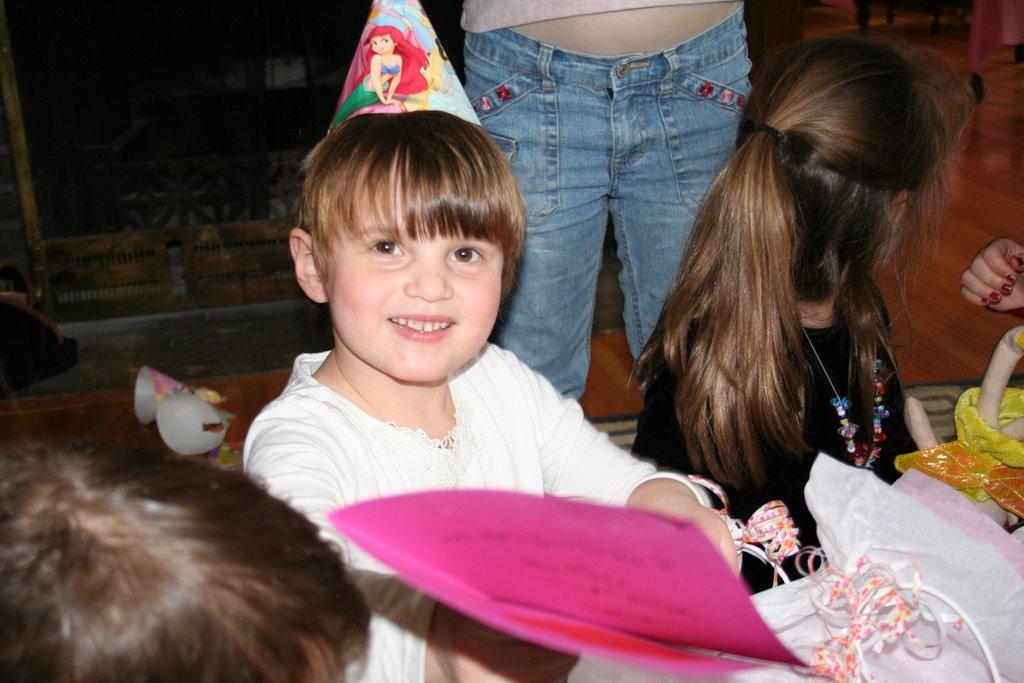
The picture above was taken of the Graham piece. The FYO and I were separated by a pane of glass/two-way mirror to get that effect.